What is FOD, and what should be kept in mind when dealing with foreign objects?
In day-to-day operations, foreign objects in products are a common problem. The abbreviation FOD is often used in this context. This abbreviation has two meanings. It stands for:
Foreign Object Debris, that is, the foreign object itself
as well as
Foreign Object Damage, i.e., damage caused by foreign objects.
FOD refers to foreign objects and debris that can damage or contaminate products or assemblies and, in the worst case, pose a threat to airworthiness. Typical examples of FOD risks include
- tools, tubes, tapes, or cloths left inside the product,
- other small parts, such as screws, packaging, connectors, or paper clips
- drilling chips and cable scraps that have not been removed,
- personal items, such as smartphones, employee ID cards, pens, hair ties, as well as food and personal protective equipment
- Liquids, such as those resulting from condensation or beverages
- Surface contamination caused by dust, oil, or grease residues.
There are therefore numerous risks associated with foreign objects in both manufacturing and maintenance.
Have you checked out our e-learning course on FOD and how to handle foreign objects yet?

- 45 minutes (introductory or refresher)
- Video animated clips with voice over
- Automatic certificate sending after successful test
- FOD Programs, FOD Zones, Protective Measures, Training + Documentation, and much more.
The systematic approach to all related activities is referred to as FOD management. Its goal is to improve product safety by minimizing the risks associated with foreign objects.
There are regulations and standards that mandate measures to minimize FOD risks. First and foremost is aviation law, which requires activities to prevent foreign object debris. This applies both to EASA Part 21G ( ) in manufacturing and to Part 145 in the context of maintenance. In particular, the introduction of safety management has forced approved organizations to take another close look at FOD hazards.
The aviation standard EN 9100:2018 also requires measures to protect products by minimizing FOD risks. To support this, the FOD standard EN 9146:2019 was published, which is dedicated exclusively to the management of foreign objects.
Due to the potential hazards, many customers also require their suppliers, through specific provisions in quality assurance agreements, to implement systematic measures to reduce the risk of foreign object damage. Airbus, in particular, has been a driving force in this area in recent years. Through the Airbus Supplier Requirements (ASR) A1501, the FOD issue is systematically integrated into the supply chain. Accordingly, structured FOD measures in accordance with FOD 91 46 are required.
Benefits of Obsolescence Management
Last but not least, obsolescence management allows for more proactive cost planning. Highly developed OM systems not only include planning for the availability and interchangeability of technical components, as well as other risk-reduction measures, but also provide data for operational financial and investment planning, as well as product-related life-cycle costs.
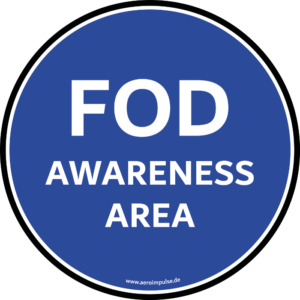
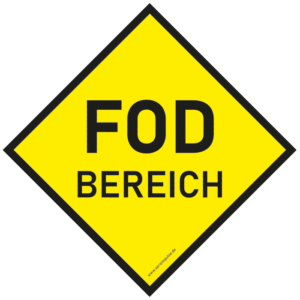
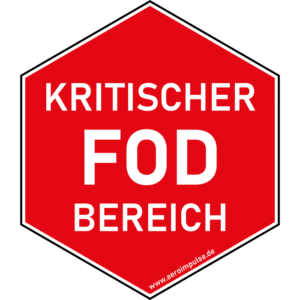
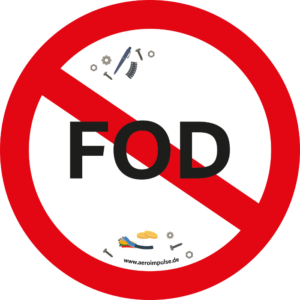
Buy FOD stickers here!
Improve visibility in FOD areas with our FOD stickers.

High-quality print on glossy adhesive film, approx. 21 cm in diameter, €4.90 each
1.  2.
2.  3.
3. 
4. 5.
5. 
Obsolescence Management Measures
Companies can take proactive or reactive measures to prevent unexpected material discontinuations by suppliers and thus avoid negative impacts on their own products. In reactive obsolescence management, action is taken only once signs of obsolescence have already become apparent. The following measures can be taken in such cases:
- Last-chance purchase of discontinued components,
- Component replacement (via interchangeability),
- Spare Parts Reconditioning,
- Partial replica,
- Change of supplier,
- Product redesign.
As with all reactive measures, companies are often limited in their choice of alternatives because action is usually required on short notice. Reactive obsolescence management is therefore often characterized by second-best solutions, increased costs, and tight deadlines.
Active obsolescence management is therefore more effective, as it counteracts product discontinuations through forward-looking planning. Obsolescence risks are addressed as early as the development phase, as required by the aviation standard EN 9100:2018. To ensure a consistently structured operational approach, a process must be developed to manage obsolescence risks. This process begins with component analyses to conduct a risk assessment based on an inventory, particularly with regard to technology, replacement, and suppliers. On this basis, the following measures, for example, can then be taken:
- Contractual agreements to ensure adequate
- Availability information from manufacturers, suppliers, and customers,
- Inventory management, including, where necessary, stocking the total demand expected in the future,
- Avoiding exotic species,
- Extending the service life of available components
- Early planning / consideration of interchangeability
Effective obsolescence management is not primarily reactive; rather, it proactively anticipates potential product discontinuations through active planning. This paves the way for alternatives in a timely manner. Particularly in the field covered by EN 9100:2018—that is, aerospace and defense—sufficient time must be allowed for the qualification of the affected component itself as well as for its system integration.
In everyday practice, however, it is evident that only a few companies currently have an active obsolescence management system in place. A key reason for this is a lack of expertise regarding process implementation and the integration of obsolescence management into day-to-day operations. Another key factor is the lack of systematically available knowledge regarding components at risk of obsolescence.
Do you need assistance with implementing FOD management?
We’re here to help!
Request a no-obligation quote at or
+49 (0)40 5131 5291
Our Books
Do you already know our books on technical aviation management?